CMS Just Opened a $100M Door for Lifestyle Medicine Startups (And Most Investors Will Miss It)
ABSTRACT
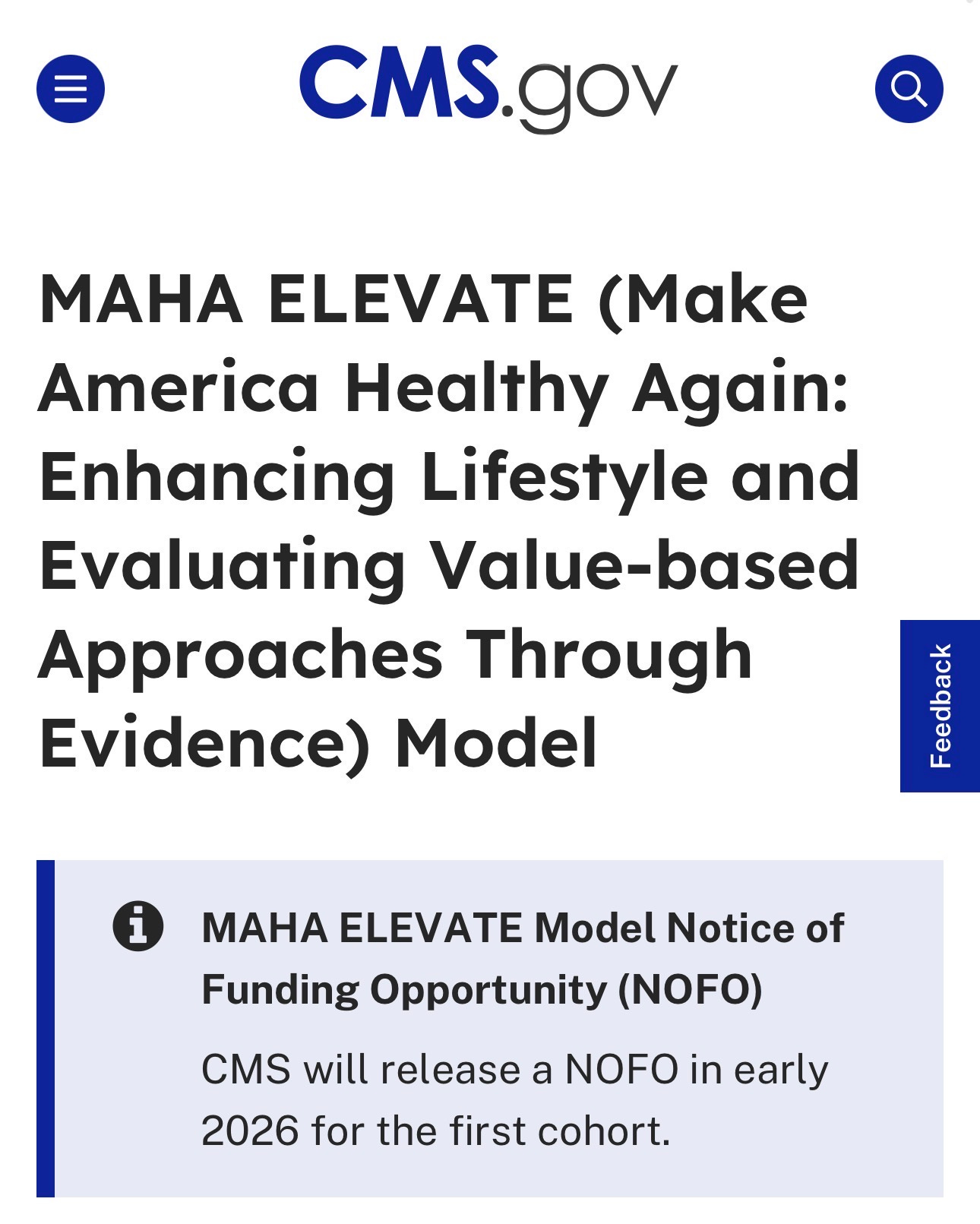
The Centers for Medicare and Medicaid Services announced the MAHA ELEVATE Model in early 2025, committing approximately $100 million in cooperative agreements to test functional and lifestyle medicine interventions for Original Medicare beneficiaries. This model represents the first time CMS Innovation Center has explicitly funded whole-person care approaches including nutrition, physical activity, stress management, and other lifestyle interventions as complements to conventional medical care. The model will award up to 30 three-year cooperative agreements across two cohorts starting in September 2026 and 2027, with three awards specifically reserved for dementia interventions. For health tech investors, MAHA ELEVATE creates several strategic opportunities: direct funding for portfolio companies or acquisition targets, validation pathways for lifestyle medicine business models, potential coverage determination precedents, and new evidence generation that could unlock broader Medicare reimbursement. This essay examines the model’s structure, analyzes which types of companies and interventions are best positioned to win awards, explores the downstream market implications for digital health investors, and identifies the specific company characteristics and intervention modalities most likely to succeed in the application process.
TABLE OF CONTENTS
What CMS Actually Just Did (And Why It Matters)
The Money Math and Award Structure
Who’s Positioned to Win These Awards
The Strategic Value Beyond the Funding
What This Means for Your Portfolio (Current and Future)
The Gaps Nobody’s Talking About
How to Think About This as an Investor
WHAT CMS ACTUALLY JUST DID (AND WHY IT MATTERS)
The MAHA ELEVATE model announcement might look like just another CMS Innovation Center pilot program, and if you treat it that way you’re going to miss what’s actually interesting here. Yes, it’s $100 million spread across 30 awards over three years, which in the context of Medicare spending is basically a rounding error. But the significance isn’t in the absolute dollars, it’s in what CMS is explicitly funding for the first time and what that signals about the direction of coverage policy.
Let’s start with what makes this different. CMS Innovation Center has run dozens of models testing various value-based payment arrangements, care coordination programs, and disease management interventions. Almost all of them involve restructuring payment for services that Medicare already covers or creating new delivery mechanisms for existing covered benefits. MAHA ELEVATE is explicitly designed to test interventions that Original Medicare does NOT currently cover. The Notice says proposals should include services not already covered by Original Medicare but with documented evidence of efficacy. That’s a fundamentally different premise.
What kinds of services are we talking about? The model focuses on functional and lifestyle medicine, which CMS defines as whole-person approaches combining psychological, nutritional, and physical interventions. Critical areas of focus include nutrition, physical activity, sleep, stress management, harmful substance avoidance, and social connection. These are exactly the kinds of interventions that digital health companies have been building for years but struggling to get Medicare to pay for. Every proposal must incorporate either nutrition or physical activity as part of the design, which tells you where CMS thinks the evidence base is strongest.
The timing matters too. This announcement came in early 2025 as part of what CMS describes as the Administration’s bold plan to reform America’s health systems to address the chronic disease epidemic. Whether you think the political framing is genuine or performative, the substantive policy shift is real. CMS is acknowledging that the current reactive, symptom-focused approach to chronic disease management isn’t working and that proactive lifestyle interventions deserve systematic evaluation in the Medicare population. That’s not a small thing.
The chronic disease statistics that CMS cites provide context for why they’re doing this. In 2022, approximately 45% of people with Medicare had four or more chronic conditions, and people with chronic conditions accounted for nearly 90% of total health care spending. The American health system primarily focuses on treating the symptoms of these conditions and managing diseases. That’s the problem statement. The implied solution is shifting upstream to prevention and lifestyle modification before chronic diseases develop or progress. CMS has talked about this conceptually for years but hasn’t put serious money behind testing lifestyle interventions until now.
There’s also something culturally significant happening here with the naming. MAHA stands for Make America Healthy Again, which is obviously political branding. But the actual model design (Enhancing Lifestyle and Evaluating Value-based Approaches Through Evidence) is substantively reasonable. CMS is funding evidence-based interventions with documented prior success, requiring rigorous data collection, and explicitly positioning these services as supplements to conventional medical care rather than replacements. The safeguards are actually pretty strong. Proposals with evidence of harm or substantial risk of harm will be excluded, recipients must comply with HIPAA requirements, and CMS will monitor programs for safety concerns and can disenroll recipients who fail to meet quality or safety standards.
What CMS is NOT doing is also important. They’re not making coverage determinations based on this model yet. They’re not changing Medicare benefits or coverage. They’re not allowing these services to replace traditional medical care. Beneficiaries who participate keep all standard Medicare protections and can continue to see any Original Medicare provider. The model is explicitly designed to gather and evaluate new data on cost and quality to inform future interventions and potentially inform future coverage determinations or future CMS Innovation Center models. So this is fundamentally an evidence generation exercise with the possibility of leading to broader coverage down the road.
THE MONEY MATH AND AWARD STRUCTURE
Let’s talk about the actual funding structure because the details matter for understanding who can realistically compete for these awards. CMS will fund up to 30 cooperative agreements with a total budget of approximately $100 million over a three-year performance period. That works out to an average of about $3.3 million per award over three years, or roughly $1.1 million per year per recipient. But CMS says “up to 30” which means they could fund fewer awards at higher amounts if the proposals warrant it.
The awards will be distributed across two cohorts. The first cohort launches September 1, 2026, and CMS will release the Notice of Funding Opportunity for this cohort in early 2026. The second cohort launches in 2027. CMS hasn’t specified the split between cohorts but a reasonable assumption is 15 awards in each cohort, though it could skew toward the first cohort being larger if they want to get more data faster.
Three awards will be reserved specifically for interventions that address dementia. This is interesting because dementia is one of the fastest-growing cost drivers in Medicare and there’s limited evidence on whether lifestyle interventions can slow cognitive decline in older populations. CMS is basically creating a carve-out to ensure they get dementia-focused proposals even if they’re not the highest-scoring applications in the general pool. If you have a company or intervention specifically targeting dementia prevention or progression, you’re competing for one of three reserved slots rather than one of 27 general slots, which changes your odds significantly.
The cooperative agreement funding can be used to cover whole-person care services including functional or lifestyle medicine that Original Medicare doesn’t cover. It can only be used for Original Medicare patients. It can also cover costs for administration and data collection and reporting. Importantly, it cannot be used to cover food or for services that can be billed to Original Medicare. That food exclusion is going to eliminate certain kinds of nutrition interventions or at least require creative structuring. If your intervention involves delivering medically tailored meals, the funding can’t pay for the actual food costs, though it could presumably pay for the nutritional counseling, care coordination, and delivery infrastructure around the food.
Organizations can submit multiple applications and receive multiple awards, but each proposed intervention must be substantially distinct. CMS may ask organizations to combine related proposals into a single comprehensive proposal. This means if you’re a company with several different program modalities or target populations, you could potentially capture multiple awards. But you need to be strategic about how distinct your proposals actually are, because if CMS views them as variations on the same intervention they’ll force you to consolidate.
The performance period is three years, which is long enough to generate meaningful outcomes data but short enough that companies need interventions that show results relatively quickly. If your theory of change requires five years to demonstrate impact on chronic disease progression, this probably isn’t the right funding mechanism. CMS wants to see documented improvements in health within the three-year window so they can make informed decisions about broader coverage or follow-on models.
Awardees will work with CMS to create a plan for data collection, quality measurement, recruitment and cost containment. This is cooperative agreement language, which means it’s not just a grant where CMS gives you money and you do your thing. CMS will be actively involved in shaping your data collection protocols, quality metrics, and program design. If you’re a startup that’s never worked with CMS before, this collaboration could be either incredibly valuable for future coverage pathways or incredibly painful depending on how bureaucratic the process becomes.
WHO’S POSITIONED TO WIN THESE AWARDS
The Notice provides pretty clear criteria for what CMS is looking for, and if you map those criteria against the current landscape of lifestyle medicine and digital health companies, certain archetypes emerge as stronger candidates.
First, CMS wants proposals with documented scientific evidence of the intervention’s safety, efficacy and cost impact for the target population. They’re also requiring applicants to provide data showing outcomes from their own program implementation prior to applying. This is a big deal because it eliminates purely theoretical interventions or early-stage companies without operational track records. You need published evidence supporting your intervention modality AND you need your own real-world data from prior program implementation. That combination points toward companies that have been operating for at least a few years, have served enough patients to generate meaningful outcomes data, and ideally have published peer-reviewed research or have their interventions based on published research protocols.
Companies that come to mind include Omada Health for diabetes prevention and chronic disease management, Noom for weight management with a behavior change focus, Virta Health for type 2 diabetes reversal through nutritional ketosis, Foodsmart (formerly Zipongo) for nutrition-based chronic disease management, and Headspace or Calm for mental health and stress management interventions. These companies have published outcomes data, have served thousands or tens of thousands of patients, and have interventions grounded in evidence-based protocols.
The requirement that all proposals must incorporate nutrition or physical activity as part of the design further narrows the field. Pure mental health or sleep interventions won’t qualify unless they incorporate a nutrition or physical activity component. This favors companies with integrated whole-person approaches rather than point solutions. It also favors companies working in metabolic health, weight management, diabetes prevention, and cardiovascular disease management, since those conditions have the strongest evidence base connecting lifestyle interventions to clinical outcomes.
CMS also wants applicants who can demonstrate past experience with data collection or the ability to accurately collect and report all required data from beneficiary enrollees in a timely manner, with appropriate data protections in place. This is where companies with health plan contracts or prior CMS program experience have an advantage. If you’ve already been collecting and reporting HEDIS measures for Medicare Advantage plans or participating in other CMS programs, you understand the data infrastructure and compliance requirements. If you’re a consumer wellness app that’s never dealt with HIPAA-compliant data collection and reporting to CMS, you’re going to have a steep learning curve.
The model is also looking for organizations with experience integrating and measuring the impact of approaches to health and wellness with scientifically documented improvements in health. The word “integrating” suggests CMS values organizations that can coordinate across multiple intervention types rather than delivering a single modality in isolation. This points toward platform companies or integrated delivery organizations rather than single-purpose apps.
Provider organizations are probably going to be strong candidates too. Functional medicine clinics like Cleveland Clinic’s Center for Functional Medicine or academic medical centers with lifestyle medicine programs have the clinical infrastructure, data collection capabilities, and published research that CMS is looking for. They may not be as tech-forward as digital health startups, but they have credibility with CMS and established patient populations.
Another category that might do well is community-based organizations with track records in chronic disease prevention. YMCA’s Diabetes Prevention Program is the canonical example, having gone through the CDC recognition process and established evidence of effectiveness. Organizations like that have the documented outcomes, experience with program delivery at scale, and relationships with Medicare beneficiaries that CMS values.
One interesting dynamic is whether digital health companies will apply directly or partner with provider organizations or community-based organizations to apply jointly. A digital health company might have the technology platform and intervention design but lack the clinical credibility or patient recruitment capabilities that a health system or community organization could provide. Conversely, provider organizations might have the patients and clinical infrastructure but lack the technology and data analytics capabilities that digital health companies offer. Strategic partnerships for the application process could strengthen proposals on both sides.
The three reserved awards for dementia interventions create a specific opportunity for companies working in brain health and cognitive decline. Companies like BrainCheck for cognitive assessment, Linus Health for brain health management, or Bold (formerly Neurotrack) for cognitive health and dementia risk reduction could be candidates. The challenge is that the evidence base for lifestyle interventions reversing or slowing dementia progression is still emerging, so applicants will need to be careful about what outcomes they promise and what existing evidence they can point to.
THE STRATEGIC VALUE BEYOND THE FUNDING
If you’re evaluating this purely on the direct funding math, $1.1 million per year for three years is nice but not transformative for most companies. An early-stage startup might find that material, but for companies that have already raised Series A or later rounds, it’s not make-or-break money. The real value is strategic, and there are several layers to unpack.
First, winning a MAHA ELEVATE award is a major validation signal. CMS is essentially saying your intervention has sufficient evidence and promise that taxpayers should fund research on it with Medicare beneficiaries. That’s incredibly valuable for future fundraising conversations, health plan sales discussions, and provider partnerships. You can credibly say you’re a CMS Innovation Center testing partner, which puts you in a different category than competitors who haven’t achieved that status.
Second, the evidence generation process creates potential pathways to broader Medicare coverage. CMS explicitly states that interventions tested in MAHA ELEVATE will inform future Original Medicare coverage determinations or potential future CMS Innovation Center models. If your intervention demonstrates strong clinical outcomes and cost savings during the three-year performance period, you’ve created the evidence base that CMS needs to make a national coverage determination or design a follow-on model with broader reach and potentially fee-for-service reimbursement. That’s the ultimate prize because it unlocks the entire $900 billion Medicare market rather than just a $100 million pilot.
The coverage determination pathway is worth dwelling on because it’s historically been nearly impossible for lifestyle interventions to achieve. CMS coverage is driven by the “reasonable and necessary” standard, which requires clinical evidence that an intervention improves health outcomes for the Medicare population specifically. Most lifestyle medicine interventions have evidence in younger populations or in controlled research settings, but limited data in the Medicare fee-for-service population. MAHA ELEVATE creates a mechanism for generating exactly that evidence. If you can show that your nutrition intervention reduces HbA1c in Medicare beneficiaries with Type 2 diabetes and reduces total cost of care over three years, you’ve built the evidentiary foundation for a coverage claim.
Third, participating in MAHA ELEVATE gives you deep operational experience with CMS processes, data requirements, and quality measurement. This is valuable institutional knowledge that makes you more competitive for future CMS programs. You’ll understand how to structure interventions to meet CMS quality measures, how to recruit and retain Medicare beneficiaries, how to collect and report data in CMS-compatible formats, and how to navigate the cooperative agreement relationship. All of that makes you more attractive to health plans and other payers who want vendors with proven CMS experience.
Fourth, the model gives you access to Original Medicare beneficiaries, which is a population that’s historically been hard for digital health companies to reach. Medicare Advantage plans are more accessible because they’re commercial entities with flexibility to cover innovative services, but Original Medicare beneficiaries often have less awareness of digital health options and fewer pathways to access services not covered by traditional Medicare. MAHA ELEVATE creates a mechanism for enrolling those beneficiaries in your program with CMS funding and support.
Fifth, there’s a competitive moat dynamic. If only 30 organizations receive awards and three years is enough time to generate compelling evidence, the winners could establish themselves as the evidence-backed leaders in their respective intervention categories. Future health plans or CMS programs looking to contract for lifestyle medicine services will naturally gravitate toward organizations that participated in MAHA ELEVATE and demonstrated results. Being outside that group of 30 means you’re competing without the CMS seal of approval.
The flip side is that participating in MAHA ELEVATE also carries risks and costs. The cooperative agreement structure means CMS involvement in program design and operations, which could slow down iteration and innovation. The data collection and reporting requirements will consume internal resources. If your intervention doesn’t demonstrate positive results during the three-year period, you’ve generated evidence against your own business model. And if CMS publicizes results across all 30 recipients, negative results or mediocre performance could damage your market position.
WHAT THIS MEANS FOR YOUR PORTFOLIO (CURRENT AND FUTURE)
If you’re a health tech angel investor, there are several immediate tactical implications and some longer-term strategic considerations.
On the tactical side, if you have portfolio companies that fit the MAHA ELEVATE profile, you should be pushing them to apply. The Notice of Funding Opportunity comes out in early 2026 for the first cohort, so companies need to start preparing applications in the next few months. That means pulling together evidence documentation, prior program outcomes data, intervention protocols, data collection plans, and quality measurement frameworks. For companies that have been operating in metabolic health, diabetes prevention, cardiovascular disease management, or cognitive health with nutrition or physical activity components, this is probably the highest-ROI use of BD resources in 2025.
The application process for federal cooperative agreements is usually rigorous and time-consuming. Companies without prior grant writing experience may want to bring in consultants who understand federal application processes. The good news is that CMS says they’ll release detailed criteria in the NOFO, so companies will have clear guidance on what to include. The bad news is that competition will likely be fierce, and writing a winning application requires both substantive program strength and strong presentation.
For new investments, MAHA ELEVATE should influence how you evaluate lifestyle medicine and chronic disease management companies. Companies with evidence-based interventions, demonstrated outcomes in their target populations, and data infrastructure capable of supporting CMS reporting requirements just became more valuable. The optionality of MAHA ELEVATE funding and the potential for future coverage determinations is now part of the bull case. Conversely, companies with interventions that lack published evidence or don’t fit the nutrition-physical activity requirement are less likely to benefit from this tailwind.
You should also be looking at which companies are positioned to win multiple awards through distinct intervention proposals. If a company has programs targeting different chronic conditions (diabetes, hypertension, obesity) or different modalities (nutrition counseling, physical activity coaching, stress management) that could each qualify as substantially distinct interventions, they could potentially capture several awards and significantly de-risk their business model with federal funding.
The dementia carve-out creates specific opportunities in brain health investing. If you’re looking at early-stage companies in cognitive health, Alzheimer’s prevention, or dementia care, MAHA ELEVATE just increased the near-term market opportunity. Three awards reserved specifically for dementia interventions means CMS is actively seeking proposals in this space, and companies with any evidence of lifestyle interventions slowing cognitive decline should be applying.
Longer-term, MAHA ELEVATE is a signal about the direction of Medicare policy and value-based care more broadly. CMS is explicitly acknowledging that lifestyle interventions deserve systematic evaluation and funding, not just as nice-to-have wellness benefits but as potential core components of chronic disease management. If this model succeeds and generates strong evidence, it could catalyze a broader shift toward prevention and lifestyle medicine in Medicare coverage policy. That makes the entire category of companies working in nutrition, physical activity, behavioral health, and chronic disease prevention more interesting as long-term investments.
The model also validates the whole-person care and functional medicine approach that some investors have been skeptical about. If CMS is willing to put $100 million behind testing interventions that combine psychological, nutritional, and physical components to address root causes rather than symptoms, that suggests the market is moving beyond point solutions toward integrated approaches. Companies building platforms that can deliver multi-modal interventions across the full spectrum of lifestyle factors (nutrition, physical activity, sleep, stress, social connection) are more aligned with where CMS seems to be headed.
THE GAPS NOBODY’S TALKING ABOUT
There are some interesting things that MAHA ELEVATE doesn’t address or that create potential challenges that aren’t obvious from the Notice.
First, the three-year performance period may not be long enough to demonstrate the full value of lifestyle interventions for chronic disease prevention. If the theory is that nutrition and physical activity changes today prevent diabetes or cardiovascular events five or ten years from now, three years might show intermediate outcome improvements (weight loss, HbA1c reduction, blood pressure control) but not necessarily the long-term cost savings that justify coverage. CMS will be measuring cost and quality impacts over three years, but the real ROI on prevention plays out over much longer timeframes. This creates a mismatch between the evidence generation timeline and the actual value proposition of these interventions.
Second, the prohibition on using funding to cover food is going to create challenges for nutrition interventions. If you’re trying to help Medicare beneficiaries eat healthier but can’t pay for the actual healthy food, you’re limited to education, counseling, and behavior change support. That might work for beneficiaries who can afford healthy food but don’t know how to select or prepare it, but it doesn’t address the economic barriers that prevent many Medicare beneficiaries from accessing nutritious food. Medically tailored meals programs have strong evidence of reducing hospitalizations and costs in certain populations, but they won’t fit cleanly into MAHA ELEVATE unless they can structure the intervention to separate the food costs from the services.
Third, the focus on Original Medicare beneficiaries rather than Medicare Advantage creates some recruitment and operational challenges. Original Medicare beneficiaries tend to be older, sicker, and less engaged with care management programs compared to Medicare Advantage enrollees. They’re also harder to identify and reach since they’re not enrolled in managed care plans with care coordination infrastructure. Companies will need to develop novel recruitment strategies, potentially partnering with providers or community organizations that serve Original Medicare populations. The patient activation and engagement levels might also be lower than what companies are used to in commercial or Medicare Advantage populations, which could affect outcomes.
Fourth, there’s a potential adverse selection dynamic where the Medicare beneficiaries who choose to participate in lifestyle medicine programs are systematically different from those who don’t. If program participants are more motivated, more health-literate, and already predisposed to behavior change, the results may not generalize to the broader Medicare population. CMS will need to be thoughtful about how they evaluate intervention effectiveness and whether positive results are due to the intervention itself or selection effects.
Fifth, the model doesn’t directly address reimbursement sustainability after the three-year performance period ends. If an intervention demonstrates strong results and beneficiaries want to continue receiving services, what happens when the cooperative agreement funding runs out? Unless CMS makes a coverage determination or creates a follow-on model, there’s no automatic payment mechanism. Companies could find themselves with strong evidence of effectiveness but no way to get paid for ongoing service delivery. This creates a risk that successful programs create unmet demand without solving the fundamental payment problem.
Sixth, the competitive dynamic among the 30 award recipients could get weird. CMS is funding multiple interventions to test which work best, which means recipients are implicitly competing against each other for future coverage or follow-on models. Companies might be reluctant to collaborate or share learnings if they view other recipients as competitors for the ultimate prize of Medicare coverage. CMS will need to structure the cooperative agreement relationships carefully to encourage evidence generation and shared learning rather than zero-sum competition.
HOW TO THINK ABOUT THIS AS AN INVESTOR
MAHA ELEVATE is fundamentally a de-risking mechanism for a category of healthcare interventions that have struggled with Medicare reimbursement. Lifestyle medicine and chronic disease prevention companies have always had a chicken-and-egg problem where they couldn’t get Medicare coverage without evidence of effectiveness in the Medicare population, but they couldn’t generate that evidence without funding to serve Medicare beneficiaries. MAHA ELEVATE solves that problem for up to 30 organizations by providing the funding to generate the evidence.
As an investor, you should view this as reducing execution risk for companies in your portfolio that win awards and increasing competitive risk for companies that don’t. If your portfolio company applies and wins, they get validation, funding, evidence generation, and optionality on future coverage. If they apply and lose, they need to understand why their proposal wasn’t competitive and whether that signals fundamental weaknesses in their evidence base or intervention design. If they don’t apply at all, you need to understand whether that’s because they don’t fit the criteria or because they’re not thinking strategically about Medicare market access.
The $100 million funding pool is small enough that not every good company will win an award, so losing doesn’t necessarily mean the business is flawed. But winning creates meaningful strategic value that compounds over time through coverage pathways, CMS relationships, and competitive positioning. Companies that are serious about the Medicare market should be treating MAHA ELEVATE as a high-priority opportunity.
For new investments, MAHA ELEVATE changes the risk-reward calculus for lifestyle medicine and chronic disease prevention companies. The existence of this model makes it more likely that strong interventions can achieve Medicare coverage, which significantly increases total addressable market. But it also means the competitive landscape will include CMS-validated players with published evidence from three-year Medicare population studies. If you’re investing in a company that wouldn’t be competitive for MAHA ELEVATE awards, you need to understand what their path to Medicare market access looks like without CMS support.
The broader signal is that CMS is serious about shifting toward prevention and lifestyle interventions as complements to conventional medical care. That doesn’t mean every lifestyle medicine company will succeed or that Medicare coverage is guaranteed for interventions that show positive results in MAHA ELEVATE. But it does mean the policy environment is more favorable than it has been historically, and companies that can generate rigorous evidence of clinical effectiveness and cost savings in Medicare populations have a viable path to reimbursement.
One final consideration is that MAHA ELEVATE creates information asymmetries that sophisticated investors can exploit. Most healthcare investors aren’t paying attention to CMS Innovation Center model announcements or thinking about cooperative agreement opportunities. If you’re actively monitoring these programs and helping portfolio companies navigate the application process, you’re creating value that less engaged investors won’t capture. Similarly, understanding which companies are applying for awards and how their applications are structured gives you insight into their strategic positioning and evidence strength that isn’t visible from public disclosures.
The Notice of Funding Opportunity in early 2026 will provide much more detail on application requirements, evaluation criteria, and program specifics. That’s when the tactical opportunities become clearer. But the strategic opportunity is already visible: CMS is putting real money behind testing lifestyle interventions in Medicare, and the companies that execute well have a path to transforming evidence into coverage and coverage into sustainable business models at scale. For investors who understand the Medicare market and can identify companies with the right combination of evidence, operational capabilities, and intervention design, MAHA ELEVATE just made this category considerably more interesting.

No comments:
Post a Comment