Now You See? Former CBS Reporter and Media Professional exposes the mind manipulation used by special interest groups, media, and medical. Share.
What is the reality ?
Specialty interests disguise their true role.
Astro-turf-fake grass is in the media. Astro-turfers seeks to manipulate you. They attack the truth, disseminate chaos, conflicting studies, multiple experts and yes, WIKIPEDIA.
Wikipedia is not peer reviewed, nor edited. It conflicted with peer reviewed articles 90% of the time.
Drug companies manipulate Google search engines, finance positive studies for drugs, CME lectures are often funded by pharma companies.
Pharma often 'stimulates' epidemics and new disorders to promote their new drugs.
How do you separate fact from fiction?
1. Use of inflammatory language
2 Claim to debunk myths
3. Beware attacks
4. Astroturfers question those who question authority.
All of this ponts to a lack of integrity
Another Medical Moment from Health Train Express
(21) Facebook
Thursday, April 6, 2017

For a trip to the ER, some are opting for Uber over an ambulance

Technology disruption in one field can precipitate a cascade of events resulting in a sea-change in another. In health care this is happening for transportation to hospitals.
Uber has found a new spot for transporting non-acute patients to emergency rooms. Some patients may also find it useful for events such as asthma and/or other non life threatening events.
Uber however may find itself in a legal dilemna transporting patients with medical conditions requiring assistance if interventions may be necessary.
At this point I would not expect Uber to be self-policing. They should require drivers to be BCLS certified and qualified in first aid. There are many scenarios that would call into question this practice.
For a trip to the ER, some are opting for Uber over an ambulance
Wednesday, April 5, 2017
Physician Suicide--An Epidemic
Pamela Wible runs "The Ideal Medical Clinic". She also is an advocate for prevention of Physician Suicide.
Dear Pamela, I’ve never been so happy to fail at something in my life. Four weeks ago today I died. Cardiopulmonary arrest in jail. Why was I in jail? My wife alerted the police. Sheriff deputies were upset when I did not pull over to talk to them after overdosing. After boxing me in, they threw me from my truck into the slushy street and tased me. After charging me with a felony and two misdemeanors, they nearly provided the perfect assist to my suicide. Through a series of miracles I was brought back. I am missing four days of my life including three on life support, but I am alive. I have to repair almost every relationship I treasure from the betrayal of my weakness, a chore I will perform with as much love and patience as I can muster. I may never practice my specialty again, but I am alive. My family has a husband, father, son, and brother.............
In this podcast, I share insights from a doc who barely survived his suicide attempt plus simple ways to prevent the next suicide. Listen in. You may save a life.
Dear Pamela, I’ve never been so happy to fail at something in my life. Four weeks ago today I died. Cardiopulmonary arrest in jail. Why was I in jail? My wife alerted the police. Sheriff deputies were upset when I did not pull over to talk to them after overdosing. After boxing me in, they threw me from my truck into the slushy street and tased me. After charging me with a felony and two misdemeanors, they nearly provided the perfect assist to my suicide. Through a series of miracles I was brought back. I am missing four days of my life including three on life support, but I am alive. I have to repair almost every relationship I treasure from the betrayal of my weakness, a chore I will perform with as much love and patience as I can muster. I may never practice my specialty again, but I am alive. My family has a husband, father, son, and brother.............
I had just lost a young girl in the ER a few weeks before. Influenza. I followed proper protocol, gave her a couple of treatments and she felt better so I discharged her home with appropriate warnings. Thirty hours later she came back, in respiratory arrest. She ended up on life support with family refusing to withdraw care. They, of course, blamed me. And, of course, complained.
My review was days later. While my employers were very sorry about the case and stated support for me, the result would likely lead to termination due to this incident and a few other cases that were trivial. I thanked them for their honesty. At first my wife and I talked about it, and I was fine. I could likely go back full time where I used to work. I returned to work that night sad, but comfortable with my likely outcome. When I got home in the early morning hours I was just sad. I cried for the girl and her family. I cried myself to sleep and woke up still sad.
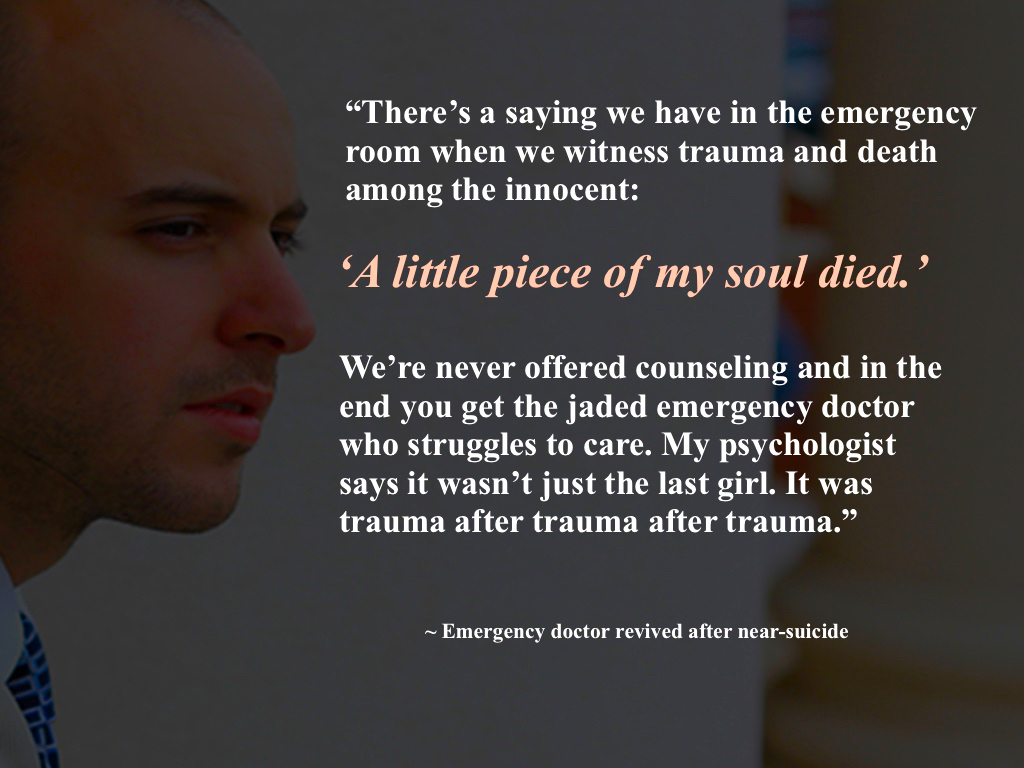
There’s a saying we have in the emergency room when we witness trauma and death among the innocent: “A little piece of my soul died.” We’re never offered counseling and in the end you get the jaded emergency doctor who struggles to care. My psychologist says it wasn’t just the last girl. It was trauma after trauma after trauma.
Pretty sure I have PTSD from the Haiti rescue and recovery trip. From bloated bodies liquifying in the heat to starving kids begging in the street. Years later, walking into a Mexican hotel with similar tiles and stucco walls, I was overwhelmed by the smell of rotting flesh. Other times when opening a large perirectal abscess, I could smell dead bodies.
Sitting alone with my grief, I grabbed what I needed and drove up to the mountains. I thought my wife would be better off without me. I texted: “I’m so sorry. You deserve better. I have tried to be strong. I can’t take it any more. To have that girl die was too much. To have to face being terminated for it? I can’t go on. I’m sorry. I love you to the end of the world and back but after one final hurt, I can finally stop hurting you. You have your family and church to help you and you have your finances taken care of.”
I took a handful of pills with the final thoughts that my student loan debt would not pass on to my wife and at least she has my life insurance to take care of her. Then came the police cars. I don’t know why, except not wanting to talk to them or face my wife, I continued driving. I obeyed all traffic laws, never exceeded 22 mph and in no way endangered pedestrians or other motorists. At one point I pulled to the side, and multiple officers took cover and aimed guns at me. They wanted to know if I had guns, and I told them that they were in the vehicle and they could have them. I kept my hands visible as directed but refused to exit the truck because I did not want to talk to them. Ultimately, I was thrown from the truck, tasered, cuffed, and put in the back of a police car.
commentary: Police are no longer there to protect and serve...This makes me very angry!
I requested to go to the hospital. I was surprised that they took me to jail. Seemed weird because I thought all suicidal people came to the hospital first. I started to get sick from the overdose. Sweating and nauseated and a little unstable on my feet. They had me sit in a holding cell in the booking area, and that’s the last I remember.
Police need to be trained in communicating with emotionally disturbed people. Police department and authorities are totally negligent and culpable for many events.
Of the next four days I have almost no memory. I am told I went into respiratory then cardiac arrest in the jail and they started CPR. I was finally transported to the hospital, where they got a pulse back. I was critically ill on ventilator support. My family was told I was going to die. Then my sweet daughter found what I took, and the appropriate meds were given. I improved. Couple days later I was off the vent and out of the ICU.
Almost every day, since that worst day, my wife just looks at me and repeats “I can’t believe it even happened!” The people I’ve told about this are utterly shocked. I have spoken with a few residents I used to teach and they can’t believe it. I can’t either.Seemingly without warning. Could happen to any doctor.
Doctors, Don’t let your job suck the life out of you
Monday, April 3, 2017

Saturday, April 1, 2017
AAMC increases projection of physician shortage up to 100K | Healthcare Dive
AAMC increases projection of physician shortage up to 100K

- The Association of American Medical Colleges' (AAMC) new estimates of the country's growing physician shortage shows it will range from 34,600 to 88,000 doctors by 2025 and from 40,800 to 104,900 by 2030.
- The AAMC's estimates in 2016 showed a projected shortage ranging between 61,700 and 94,700 by 2025.
- The number of new physicians is "not keeping pace with the healthcare demands of a growing and aging population," according to the study conducted by a division of the global information company IHS Markit.
- The growing awareness of the physician shortage has helped many in the healthcare industry develop new strategies to better help the dwindling amount of medical professionals meet the increased demand for care services, which is partly due to a larger portion of the population having health insurance coverage.These range from allowing nurse practitioners to practice independently to easing at least some of doctors' administrative burdens. The number of administrative tasks that physicians are required to do on a daily basis, including imputing health data into electronic health record systems, has been continuously cited as the main cause of burnout by physicians who have responded to surveys like the one conducted by Medscape.A medical student and a radiation oncology specialist wrote a shared byline published by Stat on Tuesday that argues addressing the concerns medical professionals have with debt and their financial stress will help prevent burnout and depression. They offered "six strategic solutions" to focus on, such as limiting tuition increases and increasing federal funding.However, the shortage is not just among physicians but also among nurses. A report released earlier this month shows nearly half of surveyed nurses (49.8%) are considering leaving the profession, which will in turn exacerbate the problem at a time when the country's aging population will continue to increase the demand for care.“By 2030, the U.S. population of Americans aged 65 and older will grow by 55%, which makes the projected shortage especially troubling,” AAMC President and CEO Darrell G. Kirch said in a statement. “As patients get older, they need two to three times as many services, mostly in specialty care, which is where the shortages are particularly severe.”The AAMC once again recommended a multi pronged solution to the problem. This includes "expanding medical school class size, innovating in care delivery and team-based care, making better use of technology, and increasing federal support for an additional 3,000 new residency positions per year over the next five years."
- Physician burnout: What can be done

AAMC increases projection of physician shortage up to 100K | Healthcare Dive
AMR teams up with Lyft for nonemergency patient rides | Healthcare Dive
AMR teams up with Lyft for nonemergency patient rides

- American Medical Response has partnered with rideshare firm Lyft to provide nonemergency transportation for patients in 42 states where the ambulance company operates.
- Hospitals and caregivers can arrange for Lyft rides via AMR’s One Call phone or online portal services.
-
While millions have gained health coverage under the Affordable Care Act, many still face barriers to care because of transportation. Community hospitals average 62 no-shows a day, at an annual cost of $3 million, according to a study by BMC Health Services Research. For teaching hospitals, no-show and late arrival rates average 25% and 31%, respectively.
Patients with multiple chronic conditions, the poor and the elderly are especially likely to need assistance with transportation. According to the Centers for Disease Control and Prevention, lack of access to transportation, along with finances and scarcity of specialists, particularly in rural areas, partially accounts for delayed care and unmet medical needs.
The efforts by ridesharing companies are good news not only for hospitals, but for the federal government as well, which spends an estimated $2.7 billion a year on nonemergency medical transportation. That figure is expected to grow under Medicaid expansion. To boost ACA enrollment for 2017, HHS partnered with Lyft to provide discounted rides during Open Enrollment events last fall.
Lyft also provides nonemergency rides to New York City Medicaid patients via the National Medtrans Network and through a partnership with Carelinx.
- Recent advances and integration of mobile applications such as Lyft and Uber will increase availability and accessibility for patients needing transportation. It remains to be seen if payors and medicare will accept this mode for reimbursement without further qualifications.
While millions have gained health coverage under the Affordable Care Act, many still face barriers to care because of transportation. Community hospitals average 62 no-shows a day, at an annual cost of $3 million, according to a study by BMC Health Services Research. For teaching hospitals, no-show and late arrival rates average 25% and 31%, respectively.
Patients with multiple chronic conditions, the poor and the elderly are especially likely to need assistance with transportation. According to the Centers for Disease Control and Prevention, lack of access to transportation, along with finances and scarcity of specialists, particularly in rural areas, partially accounts for delayed care and unmet medical needs.
The efforts by ridesharing companies are good news not only for hospitals, but for the federal government as well, which spends an estimated $2.7 billion a year on nonemergency medical transportation. That figure is expected to grow under Medicaid expansion. To boost ACA enrollment for 2017, HHS partnered with Lyft to provide discounted rides during Open Enrollment events last fall.
Lyft also provides nonemergency rides to New York City Medicaid patients via the National Medtrans Network and through a partnership with Carelinx.
Will Lyft drivers be qualified in CPR, or to assist chronically impaired riders?
AMR teams up with Lyft for nonemergency patient rides | Healthcare Dive
Future Pandemics INFOGRAPHIC
As predictions go, pandemics are one of the scariest. Inevitable and with a huge unknown quantity, pandemics are something that even the World Health Organisation are urging people not to ignore, with the frightening forecast that there will be, “sometime in the future, an event that will kill…somewhere between 80 and 90 million people.”
There are lots of hypothetical situations and theories about where a virus will come from, what it will do and the devastation it will have. In fact, there are already scientists working on vaccines that the human population may need in the event of a global outbreak. There’s actually a World Health Organisation Global Vaccine Plan!
In this infographic, we take a look at some of the possible pandemics of the future and how you can best prepare yourself against the spread of germs.

Subscribe to:
Comments (Atom)
Survival
We talk a lot about fixing healthcare, but none of it matters if the people delivering care cannot survive the system themselves. More than ...

-
David’s Health Tech Newsletter: No. 62 – “Companies Disrupting Healthcare In 2015” via reddit.com The 21st Century has shown rapid develo...
-
(click for locations) Or is it Doctor Google ? Either you are a lover or a hater of all things Google. Google however has some thing...
-
At the intersection of health, health care, and policy.At the intersection of health, health care, and policy. A Four Years Into A C...
