Thursday, March 9, 2017

MS 'brain fog' lifted after stem cell treatment


MS 'brain fog' lifted after stem cell treatment

BBC journalist Caroline Wyatt has spoken of how the "brain fog began to lift" after she had pioneering treatment for multiple sclerosis (MS).

The former BBC defence correspondent was deemed unsuitable for an NHS trial and paid $60,000 (£48,000) for a stem cell transplant in Mexico in January.

Both the FDA and the NHS criteria for suitability for clinical trials are complex and often eliminate patients who have had prior treatments which could confound and yield inaccurate results from a clinical trial.  This screening requirement eliminates large numbers of candiate volunteers from the study.   The criteria are derived from collaboration of principal investigators and the FDA.

Many patients seek out prospective treatments in other countries who have less stringent requirements for receiving new (ie, experimental treatments)

Caroline Wyatt is one of those patients.


Multiple sclerosis

In MS the protective layer surrounding nerve fibres in the brain and spinal cord - known as myelin - becomes damaged. The immune system mistakenly attacks the myelin, causing scarring or sclerosis.
The damaged myelin disrupts the nerve signals - rather like the short circuit caused by a frayed electrical cable.
If the process of inflammation and scarring is not treated then eventually the condition can cause permanent neurodegeneration.

'Aggressive treatment'

She changed jobs but, following a relapse in 2001, she was given a brain scan and told she might have MS - a diagnosis that was confirmed following more invasive tests such as a spinal tap in 2015.  Wyatt initially tried various drug treatments but as her condition began to deteriorate she began to investigate the stem cell treatment.  "I got in touch with Sheffield who were the British arm of a trial... and they very kindly agreed to see me," she said.
"They did various tests but decided in the end that medically speaking I was not one of the best candidates so they couldn't do it here."

Wyatt said that although UK bodies such as the NHS and watchdog NICE describe the treatment as experimental, about 80% of people who had the treatment responded to some degree and more than 50% saw the progression of their MS halted.

Sunday, March 5, 2017

Fake News ! It happens all the time in Medicine and HealthCare

Fake news seems to be the new mantra in many quarters.  Fake news can be actively pursued, or passively enjoyed by incomplete, inaccurate, or absent reporting.


Maintenance of Competence (MOC) is an item that few patients are aware.  Specialty boards require re-examination after initial board certification to maintain board certification.

Proponents claim that the Maintenance of Certification program was designed to help physicians keep abreast of advances in their fields, develop better practice systems, and demonstrate a commitment to lifelong learning.
Whether or not the MOC program accomplishes any of these stated goals is a matter of intense debate.
Opponents claim that the Maintenance of Certification program is overly burdensome in both time and expense, reducing time available to spend with both family and patients. The exams have had little relevance to the individual physician's practice requiring tremendous effort to relearn material not useful to daily practice, only useful for passing the board exam. There is no proof that it improves patient care and little to no supporting data except for controversial articles written by board members. Serious questions have been raised regarding Member Board finances.[2]


The AMA calls for an immediate end to MOC

RESOLVED, That our American Medical Association call for the immediate end of any mandatory, secured recertifying examination by the American Board of Medical Specialties (ABMS) or other certifying organizations as part of the recertification process for all those specialties that still require a secure, high-stakes recertification examination.
Dr Fisher explains how this came to be, and how the American Board of Medical Specialties, the AMA and other physician organizations have engaged in an alleged policy of corruption and profiteering from their own colleagues.
Continuing medical education has served well for many decades as AMA approved courses which functioned adequately to ensure professionalism and currency in medical knowledge.l These courses also are charged for by specialty societies and the AMA.
MOC seems superfluous.   State licensing authorities already require continuing medical education for each licensing period. Physicians are being doubly extorted for the 'right and privilege to earn income.
This who establish these rules are not practicing physicians. 


Saturday, March 4, 2017

Patient Safety Awareness Week United for Patient Safety Campaign


During the past ten years an effort to focus on patient safety has yielded significant gains for patient safety.  The week of March 12-18 will bring attention to providers and patients alike.  Safety is a never ending goal in day to day hospital and/or clinic operations.  When procedures become routine and repetitive studies have shown human error intrudes with short cuts or inattention to detail.

The National Patient Safety Foundation

The National Patient Safety Foundation’s vision is to create a world where patients and those who care for them are free from harm. A central voice for patient safety since 1997, NPSF partners with patients and families, the health care community, and key stakeholders to advance patient safety and health care workforce safety and disseminate strategies to prevent harm. NPSF is an independent, not-for-profit 501(c)(3) organization. 

NPSF Vision Statement

Creating a world where patients and those who care for them are free from harm.

NPSF Mission 

NPSF partners with patients and families, the health care community, and key stakeholders to advance patient safety and health care workforce safety and disseminate strategies to prevent harm.

 Improving Patient Safety in Hospitals: A Resource Listfor Users of the AHRQ Hospital Survey on PatientSafety Culture

The Agency for Healthcare Research and Quality (AHRQ) has a resource document which elaborates on many safety issues for hospitals.  It is updated annually.

The AHRQ has programs defining specific areas to be analyzed with recomendations for improvement.  It is available on their website (Quality and Patient Safety Index)


United for Patient Safety Campaign

Friday, March 3, 2017

Doc Vader Goes "Blind Melon" on Patient Demands


Looking for a hospital on WebMD or HealthGrades is NOT like finding a hotel on TRIIPADVISOR. Watch my friend, Doc Vader.


Credits go to: Zdogg MD .   Out!

Thursday, March 2, 2017

High-Volume Prescribers and Medicare Prescriptions of Opioids | Substance Use and Addictive Disorders | JAMA Internal Medicine | The JAMA Network

Who prescribes the most opiods?  Several surprises from this study from the Journal of the American Medical Association


Distribution of Opioids by Different Types of Medicare Prescribers

JAMA Intern Med. 2016;176(2):259-261. doi:10.1001/jamainternmed.2015.6662


Researchers have suggested that the opioid overdose epidemic1 is primarily driven by small groups of prolific prescribers and “corrupt pill mills.”2,3 For example, the California Workers’ Compensation Institute found that 1% of prescribers accounted for one-third of schedule II opioid prescriptions and 10% accounted for 80% of prescriptions.4 This propagates a message that opioid overprescribing is a problem of a small group of high-volume prescribers, while general use is likely safe and effective. Medicare data provide the opportunity to address the question of whether such prescribing patterns occur across a national population.


Opioid prescriptions are concentrated in specialty services in pain, anesthesia, and physical medicine and rehabilitation. By sheer volume however, total prescriptions are dominated by general practitioners (family practice, internal medicine, nurse practitioners, and physician assistants).
Contrary to the California Worker’s Compensation data showing a small subset of prescribers accounting for a disproportionately large percentage of opioid prescribing, Medicare opioid prescribing is distributed across many prescribers and is, if anything, less skewed than all drug prescribing. The trends hold up across state lines, with negligible geographic variability. Figure 2 does show greater skewing for total drug costs of Medicare opioid claims, with 78% accounted for by 10% of prescribers. This could be selection of more expensive formulations or higher doses prescribed.


The distribution of any social phenomena has some degree of skewing similar to an “80/20 rule” (eg, 20% of the population controls 80% of the wealth).6 As of 2013, however, these data argue that opioid prescribing is no more skewed than other prescribing, reflecting a widespread practice relatively indifferent to individual physicians, specialty or region. High-volume prescribers are not alone responsible for the high national volume of opioid prescriptions. Efforts to curtail national opioid overprescribing must address a broad swath of prescribers to be effective.

MEDICINE CABINET MINEFIELD, HOW OLD PRESCRIPTIONS FUEL THE OPIOID CRISIS

Medicine Cabinet Minefield: How old prescriptions dare fueling an opioid addiction cr
High-Volume Prescribers and Medicare Prescriptions of Opioids | Substance Use and Addictive Disorders | JAMA Internal Medicine | The JAMA Network

Nudging our kids and families towards better eating

Wednesday, March 1, 2017

Trump Pick for CMS Would Ease Up on Physicians


Seema Verma, MPH, President Donald Trump's choice to head the Centers for Medicare & Medicaid Services (CMS), has mixed feelings about electronic health record (EHR) systems.
It's just one example of how she's on the same page with many physicians regarding healthcare.
"My doctor…is staring at her computer instead of looking at me," the healthcare policy consultant told the US Senate Committee on Finance during her confirmation hearing yesterday.


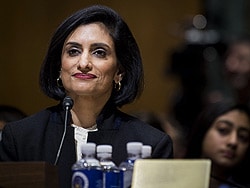
Seema Verma, CMS administrator nominee for President Trump, smiles during a Senate Finance Committee hearingWashington, DC, on Thursday, February 16, 2017. Source: Pete Marovich/Bloomberg/Getty Images

This is just one example of how provider's recommendations have been purposefully neglected in regard to electronic health records.  The energy of a vast HIT niche have been misappropriated by HHS and CMS in an undisguised effort to harness EHRs for their own interest to collect data.  Little if any effort has been made to the entology of the EHR, or its effectiveness in day to . day activities of providers.  Neither has any oversight or guidance to its usability or efficacy in patient care.
It will take some time and effort to reverse the march toward a singularity of patient care and HIT.
Donald Trump is listening to experts in most areas of government management, including health care management and reform. Billions of dollars have been spent for HIT, at least half of which has been wasted.  The well known incentives were given to providers who could ill afford the huge IT expenditures.  Without that infusion of capital it is doubtful if the IT transformation would have occured.  The special interest group here is the IT hardware and software developers.  Huge EHR firms such as Cerner, Epic and others profitted greatly.
Verma's comment came in response to a question about the future of the CMS incentive program for meaningful use of EHRs, much criticized by physicians for turning them into data entry clerks. She also recounted seeing signs in physician waiting rooms that apologized for schedule delays due to EHR implementation. Yet another tech challenge she cited was the lack of EHR interoperability, which prevents different programs from freely exchanging data.
"We need to make sure [EHR technology] is fulfilling its promise and not being more burdensome," said Verma.

Other 'key elements" will effect Regulations, Mandatory Medicare Pilot Projects,(most of which have failed), and not vetted prior to implementation. Medicare Financial Risk (imposed by a negative incentive to diminish rembursement to providers who do not participate in QA measures.

Verma has some fresh approaches to Medicaid and funding HSA accounts.

She is the architect, for example, of a "consumer-directed" Medicaid program called Healthy Indiana Plan (HIP), which gives beneficiaries there something akin to a health savings account — a Personal Wellness and Responsibility (POWER) account — to apply toward a $2500 deductible. Verma also helped create HIP 2.0, which expanded Medicaid coverage in the state under the ACA with the help of federal dollars.
Launched in 2015 when Vice President Mike Pence was Indiana's governor, HIP 2.0 requires beneficiaries to contribute 2% of their income to their POWER (a Personal Wellness and Responsibility (POWER) account each month. That skin-in-the-game entitles them to extra benefits such as dental and vision coverage.
It remains to be seen if those with limited income do have the financial capacity to contribute 2% especially if there will be copays.

The Congressional Approval Process is in motion
While Senate Democrats appeared vexed at times with Verma, Republicans, who control the Finance Committee, praised her. "We have an outstanding nominee in front of us," said Sen. Michael Enzi (R-WY). "You haven't just studied Medicaid and Medicare; you've done things."
"You have acquitted yourself very well," added Sen. Orrin Hatch (R-UT), the committee chair.
The next step in the confirmation process is for the committee to send Verma's nomination to the full Senate for a final vote.
All in all the changes which may come are encouraging to most.


Trump Pick for CMS Would Ease Up on Physicians

Survival

We talk a lot about fixing healthcare, but none of it matters if the people delivering care cannot survive the system themselves. More than ...