For patients facing stroke, epilepsy, Parkinson’s disease or other complex neurologic conditions, timely access to specialized neurologic care can shape recovery, independence and quality of life.
Across Northern California, not-for-profit health system Sutter Health is expanding how advanced neurologic care is delivered – helping patients receive the right care, at the right time, close to home.
To highlight how this work reflects Sutter’s comprehensive, integrated approach to neuroscience care, this fact sheet was created to illustrate how the service line is advancing the future of neuroscience services through expanded access, innovation and clinical excellence. Click here to enlarge the document.
Innovation With Impact
Sutter continues advancing its award‑winning, high-quality neurologic care through systemwide efforts focused on improving the speed and precision of diagnoses and treatments, and the patient experience. The following reflect just some of those efforts:
- AI-powered imaging to support earlier detection and faster triage of stroke, helping reduce diagnostic delays and improve care coordination across Sutter’s 17 certified stroke centers that collectively care for more than 6,000 stroke patients each year.
- Expanded access advanced imaging for epileptic seizure detection, including new headset technology that brings outpatient brain monitoring to rural areas and hospitals without on‑site neurologic coverage.
- Digital cognitive screening tools that help identify early signs of cognitive decline in older adults, supporting earlier diagnosis, care planning and easier access to specialty memory services, including care delivered through specialized sites like Sutter’s Ray Dolby Brain Health Center in San Francisco.
- Advanced neurosurgical and brain‑stimulation therapies – from incisionless surgery and minimally invasive options such as focused ultrasound and laser ablation to deep brain stimulation and vagus nerve stimulation – providing a comprehensive array of surgical treatment options for brain tumors, refractory epilepsy, movement disorders, and improved motor recovery after stroke.
“These advances translate into meaningful, real‑world impact for our patients and their families,” said Dr. Shawn Kile, chair of Sutter’s Advanced Neuroscience Service Line. “They help people regain independence through prompt, coordinated care and return to daily activities they once thought were out of reach.”
Investments Built to LastFor patients facing stroke, epilepsy, Parkinson’s disease or other complex neurologic conditions, timely access to specialized neurologic care can shape recovery, independence and quality of life.
Across Northern California, not-for-profit health system Sutter Health is expanding how advanced neurologic care is delivered – helping patients receive the right care, at the right time, close to home.
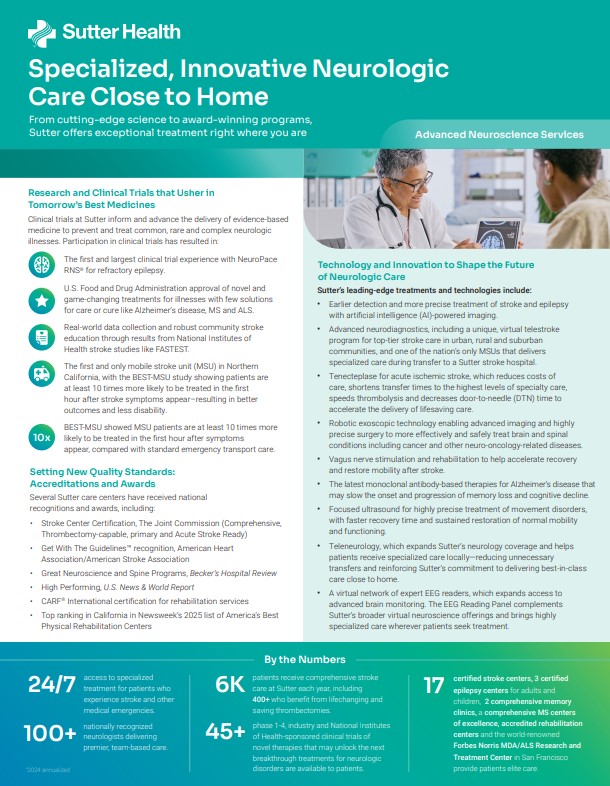 To highlight how this work reflects Sutter’s comprehensive, integrated approach to neuroscience care, this fact sheet was created to illustrate how the service line is advancing the future of neuroscience services through expanded access, innovation and clinical excellence. Click here to enlarge the document.
Innovation With Impact
Sutter continues advancing its award‑winning, high-quality neurologic care through systemwide efforts focused on improving the speed and precision of diagnoses and treatments, and the patient experience. The following reflect just some of those efforts:
- AI-powered imaging to support earlier detection and faster triage of stroke, helping reduce diagnostic delays and improve care coordination across Sutter’s 17 certified stroke centers that collectively care for more than 6,000 stroke patients each year.
- Expanded access advanced imaging for epileptic seizure detection, including new headset technology that brings outpatient brain monitoring to rural areas and hospitals without on‑site neurologic coverage.
- Digital cognitive screening tools that help identify early signs of cognitive decline in older adults, supporting earlier diagnosis, care planning and easier access to specialty memory services, including care delivered through specialized sites like Sutter’s Ray Dolby Brain Health Center in San Francisco.
- Advanced neurosurgical and brain‑stimulation therapies – from incisionless surgery and minimally invasive options such as focused ultrasound and laser ablation to deep brain stimulation and vagus nerve stimulation – providing a comprehensive array of surgical treatment options for brain tumors, refractory epilepsy, movement disorders, and improved motor recovery after stroke.
“These advances translate into meaningful, real‑world impact for our patients and their families,” said Dr. Shawn Kile, chair of Sutter’s Advanced Neuroscience Service Line. “They help people regain independence through prompt, coordinated care and return to daily activities they once thought were out of reach.”
- Ischemic Stroke (Clots):
- Thrombolytic Therapy (tPA/TNK): The "gold standard" involves administering clot-busting medications within 3 to 4.5 hours of symptom onset to dissolve blockages.
- Mechanical Thrombectomy: For large blockages, specialists use a catheter to physically remove the clot, often effective up to 24 hours after onset in certain patients.
- Hemorrhagic Stroke (Bleeding): Care focuses on controlling blood pressure, reversing blood thinners, and potentially performing surgery (like a craniotomy or aneurysm clipping) to relieve brain pressure.
- Comprehensive Stroke Centers (CSC): These facilities have the highest level of certification, with 24/7 access to advanced neurosurgery and specialized infrastructure.
- Inpatient Rehabilitation Facilities (IRF): For recovery, the AHA/ASA recommends treatment in an inpatient rehab hospital rather than a skilled nursing facility whenever possible. These programs typically provide at least 3 hours of therapy per day, 5 days a week.
- Physiatrists & Neurologists: Specialized doctors who lead the medical and recovery plan.
- Physical Therapy (PT): Focuses on mobility, balance, and motor-skill exercises.
- Occupational Therapy (OT): Helps patients relearn daily living skills like dressing and bathing.
- Speech-Language Pathology (SLP): Addresses communication disorders (aphasia) and swallowing issues (dysphagia).
- Neuropsychology: Manages the emotional and cognitive changes, such as depression or memory loss, which are common post-stroke.
- Medication Management: Strictly following regimens for blood pressure, cholesterol (often statins), and antiplatelet or anticoagulant agents.
- Lifestyle Changes: Regular exercise, a healthy diet, and smoking cessation are essential for long-term health.
- Support Systems: Peer support programs like Stroke Survivor 2 Survivor (SS2S) help navigate the transition from hospital to home.


- Seated Marching: Sit tall and alternate lifting knees toward the chest. This builds hip flexor strength for better foot clearance while walking.
- Sit-to-Stands: Transition from a seated to a standing position without using your arms. This mimics daily movements and strengthens the quadriceps and glutes.
- Ankle Dorsiflexion: Flex your foot upward toward your shin. This is critical for treating "foot drop" and preventing trips.
- Flamingo Stands: Practice standing on one leg for 30 seconds while holding a stable surface for safety. This directly challenges and improves balance.
- Tabletop Towel Slides: Place your hand on a towel and slide it forward, backward, or in circles. This improves shoulder and arm coordination through guided movement.
- Wrist Curls: While resting your forearm on a table, slowly bend your wrist up and down. You can use a light water bottle for resistance.
- Shoulder Openers: With elbows pinned to your sides, rotate your forearms outward like opening a door to improve range of motion.
- Finger Tapping: Tap each finger to your thumb sequentially. Start slow and gradually increase speed to boost dexterity.
- Coin Pickups: Practice picking up coins from a table and placing them in a cup to strengthen grip and hand-eye coordination.
- Pen Spin: For more advanced recovery, practice rotating a pen between your fingers.
- Trunk Rotations: While seated, gently twist your torso from side to side to reduce stiffness and improve walking control.
- Knee-to-Chest (Lying): While lying on your back, bring one knee toward your chest to engage abdominal muscles.
- Bridges: Lie on your back with knees bent and feet flat; lift your hips toward the ceiling to strengthen the lower back and glutes.
- Mirror Therapy: Move your unaffected limb in front of a mirror so the brain "sees" the affected limb moving, which can help rewire motor pathways.
- Constraint-Induced Movement Therapy (CIMT): Restricting the stronger limb to force the use of the affected side during daily tasks.
- Cognitive Exercises: Jigsaw puzzles, Sudoku, and reading aloud help rebuild memory, problem-solving, and speech skills.


No comments:
Post a Comment