WHY EVERYTHING GETS CHEAPER EXCEPT HEALTHCARE
There is a pattern hiding in plain sight.
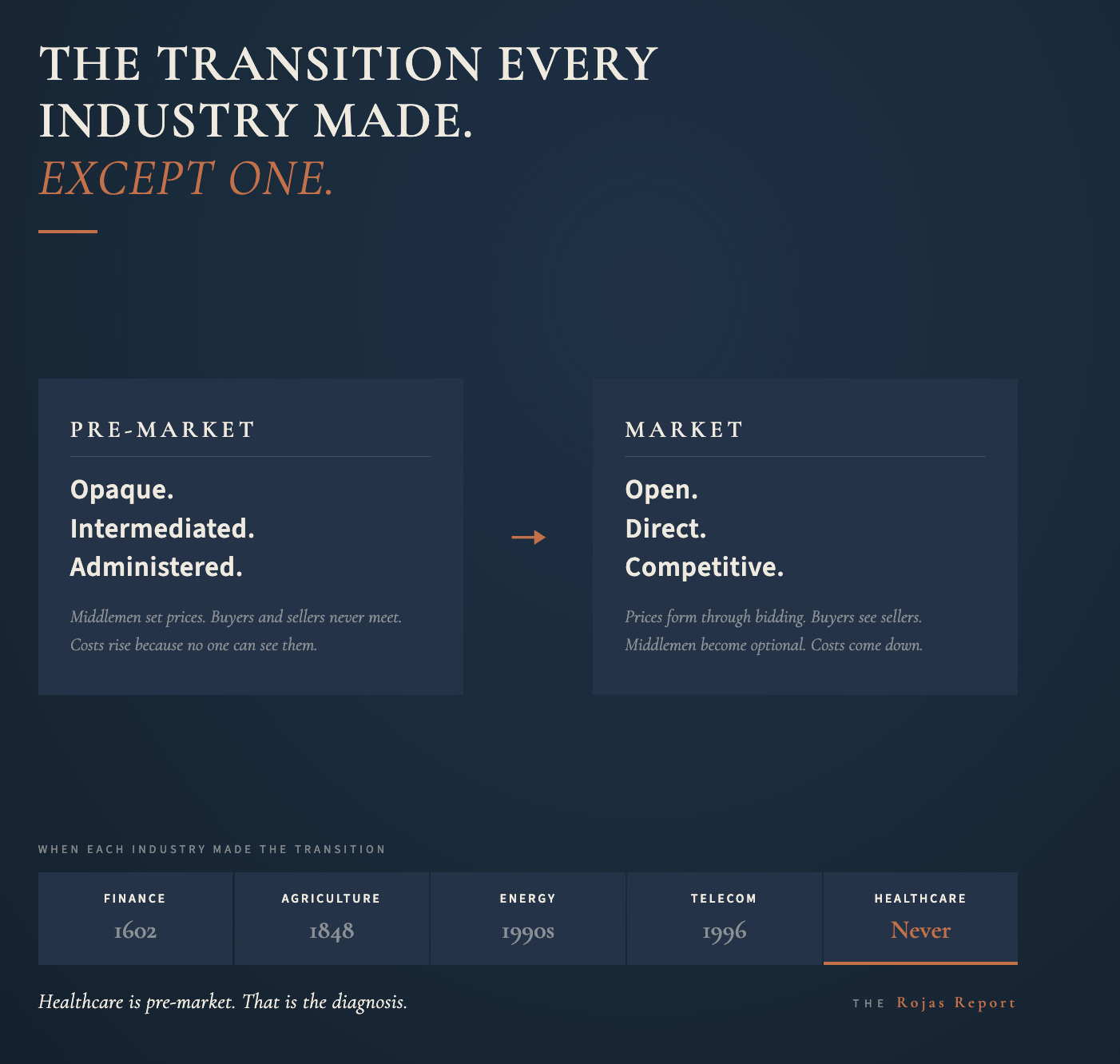
Over the last half-century, the industries that have become cheaper all share one structural feature. Energy, agriculture, freight, telecom, finance. They all went through the same transition. They moved from opaque, intermediated, and administered pricing to open markets in which buyers and sellers meet directly and prices are set through competition.
The industries that got more expensive all share a different feature. Healthcare, education, housing. They never made that transition. Prices are set by negotiation, regulation, or administrative fiat. Buyers never see sellers. Sellers never see real demand. Middlemen sit between every transaction, extracting rent from the opacity.
This is not a coincidence.
It is the single most important structural fact about American healthcare.
Healthcare is expensive because it is pre-market.
Not because of greed.
Not because of complexity.
Not because of regulation.
Because it never underwent the transition that made every other industry cheaper.
That transition has a name.
It is called market formation.
It is the oldest documented economic structure in the Western world.
THE DUTCH INVENTED THIS
The Amsterdam Bourse opened as a commodity exchange in 1530. Merchants traded grain, herring, spices, and whale oil in the open. Prices are formed through competition, not negotiation. Buyers could see sellers. Sellers could see demand. Middlemen became optional.
By 1602, the Dutch East India Company launched the world’s first stock exchange on the same site. Futures contracts, forward pricing, and hedging all originated there. London copied the model in 1659. Every modern exchange on earth descends from it.
I know this because I come from the country that built it. My family’s roots trace to the Dutch commodity markets. This is not abstract theory to me. It is heritage.
The Chicago Board of Trade brought the same structure to American agriculture in 1848. Farmers and merchants could suddenly establish predictable prices, hedge against risk, and allocate resources to the crops and regions with the highest demand. Before the exchange, agricultural prices were local, opaque, and volatile. After the exchange, they became visible, comparable, and plannable.
Energy followed in the 1990s. Wholesale electricity markets replaced vertically integrated utilities with competitive exchanges. The results were messy. California botched its market design in 2000. Texas had its own disasters. However, the places that implemented market design correctly saw costs decline. Texas electricity prices dropped 17% below the national average after genuine competition took hold.
The lesson was the same every time.
Not that markets are perfect.
That market design matters.
And that the absence of a market is not neutral.
The absence of a market is a policy choice that benefits those who profit from opacity.
There are people who celebrate when drug prices drop 30%.
And there are people who ask why they were 300% too high in the first place. This is where the second group reads.

No comments:
Post a Comment